So Japan has this sauce they use for tonkatsu (breaded pork cutlet. Link for moe info, but oh man. This stuff is some of my favorite Japanese food) that's ridiculously tasty. It ranges in consistency from syrupy with the consistency of like, gravy, to viscous and runny like Worcestershire sauce, and is absolutely delicious. Growing up, I knew it as "the tonkatsu sauce" and later as "the bulldog sauce" since the brand we often bought was Bulldog. I thought it was a weird name, but whatever, not like companies don't have weird names sometimes... and I mean, siracha sauce has a giant rooster on the front.
For the longest time while I was in Japan there was this stuff labeled ウースターソース(uusutaa sousu - pronounced kind of like "Woostaaa sauce") that I thought was oyster sauce. Ha. So wrong on that account. I was stupidly buying import Worcestershire sauce when really, it was sitting there staring me in the face. Apparently, "Worcestershire" is too hard to katakana-ize, so it just changes into "uustaa" sauce.
To digress a little, other words have gotten similar "too hard to katakana-ize treatments. There are a couple of words in Japanese for all-you-can-eat style eateries. One of them is 「食べ放題」(tabehoudai)「ブーフェ」(buufeh) and「バイキング」(baiking/viking). So tabehoudai translates as something like "all you can eat,"
buufeh is obviously from buffet... and then there's viking. We were like wtf? when my friends and I first saw it. It turns out that originally, it comes from the Scandinavian term, "smorgasbord" (supposedly, the English use of the word, as well as buffets themselves also come from this after a World Fair event that used it to showcase Swedish food) however, this proved too difficult to say, so it was changed into the easier to say, "viking." Since, you know, vikings, Scandinavia... it totally made sense. Actually, I'd be really interested in seeing if there's anything explaining that connection, or if people back then were really just like "oh hm, what else is Scandinavian? Hmmm... VIKINGS. Vikings totally ate a lot too, so let's call our all you can eat thing a viking!" Facepalm.
Anyways, back to woostaa sauce. I get emails and stuff from the Huffington Post and New York Times whenever they run food articles, so one came up for how they found the original recipe for Lea & Perrins Worcestershire Sauce in a skip that detailed what exactly went into the "spices" and "seasoning" on the ingredients label (spoiler: it's not vegetarian friendly). Things that include stuff like lemons, pickles, and anchovies. While the recipe didn't include how to make it, nor how much sauce it yielded, it was still a more complete picture of what went into the sauce since even the manufacturers often spoke in code, or didn't know the entirety of the recipe.
One of the code words they happened to use was "bulldog" or "bulldog clip" - and while I have no idea what that actually means, I have a huge hunch that those code words are the source of the childhood tonkatsu sauce I grew up with. I saw that article and went "OH MY GOD IT ALL MAKES SENSE." Apparently though, the Japanese worcestershire sauce uses pureed apples as a base though? But yeah, that's where that logo comes from (I think).
A little bit more on this Japanese Woostaa sauce: it was originally thought of as the Western equivalent of soy sauce, which is why it appears EVERYWHERE in Japan (not just at tonkatsu restaurants, but especially there too). I think it's also used in hambagu (hamburger steaks/patties) and other things... I guess kind of in the way Worcestershire sauce is actually used lol (I use it in meatballs. Nom.) Japanese cooking uses soy sauce as a flavoring, so during the later Meiji and Taisho periods (~1868 to 1926) when Japan was rapidly Westernizing in the name of modernization, Japanese chefs, when making Western foods, would use Worcestershire sauce as flavoring for like, everything (essentially, the same way they would use soy sauce for Japanese foods). That's the period when there was a huge influx of Western influence on everything in Japanese culture, from food to fashion to ways of thinking and the emergence of new "moga" modern girls who fashioned themselves off of western women (think the 20s) and read Western thinkers. The popularization of Western food is generally traced to this period, though other foods (mostly either Dutch based or Iberian) were around in the Japan from the 16th and 17th centuries. Also, lots of the Westerners in Japan at that time didn't actually come from their native countries, but were transplants from China - hence the huge British presence.
Seriously though, if you've never tried tonkatsu, it's a pretty awesome dish. Pork cutlets are breaded and then fried until crispy golden brown, and then served with tonkatsu sauce. The sauce, if you go to nicer tonkatsu specialty restaurants, is all house made, and you can grind a little bit of sesame seed into it. Delicious stuff. I'm getting ridiculously hungry thinking about it. I miss tonkatsu so much...
Tonkatsu restaurants also usually serve meals with cabbage salads and a bowl of rice, both of which you can usually refill for free - hooray, all you can eat cabbage (actually, the dressing is pretty tasty... so I usually eat a bunch of this haha). Good tonkatsu is moist inside, but has a crispy outside. Some places put cheese inside, or roll thin slices of pork around other things such as asparagus. So delicious.
...and now I really crave tonkatsu. Man, this is the problem with studying food sometimes. You get bad cravings for things when you have a bunch of food still in the refrigerator, or for food that is literally thousands of miles away...
Hint hint, parents, whom I know totally read this. Can we have tonkatsu for dinner sometime? Please? lol. Maybe I can convince my brother to make it sometime...
Sources:
Schlesinger, Fay. "Original Lea and Perrins Worcestershire Recipe Found in Skip" Mail Online. November 2009. Accessed 16 December 2012. http://www.dailymail.co.uk/femail/food/article-1224736/Original-Lea-Perrins-Worcestershire-Sauce-recipe-skip.html
Ishige, Naomichi. The History and Culture of Japanese Food. London: Kegan Paul, 2001.
Showing posts with label history. Show all posts
Showing posts with label history. Show all posts
Monday, December 17, 2012

Sunday, December 16, 2012
History Haikus
Somehow, I have managed to survive the first quarter of graduate school. Taking twenty units was super dumb, but somehow I managed to meet a lot of awesome people, have fun, and generally stay somewhat-sane, even if I did practically shut myself in my room for the last two weeks of school.
But it's all over now! Hooray! That's the good thing about quarters I guess. Before you know it, it's over.
Speaking of over, one of my neighbor boys is graduating this quarter, so he's moving out tomorrow. So sad! His program was only 4 quarters (only!), so he's departing. It's a shame though, because he was super chill; totally not what I expected from a guy in Pike haha. Maybe I judge people just a little based on those things. But D was super sweet, and part of our neighbor dinners :) Also made amazing stuffed bellpeppers. Funny, how despite only knowing the boys next door for a quarter, I feel like, actually comfortable with them. Really, we lucked out. It'll be interesting to see who moves in next door...
But yes, so, for my history class (Modern Japanese history), since we had to memorize when certain major events were (I was told we were just supposed to know generally important things, and I guess I've never really thought of dates as important), I created some haiku to help me remember lol.
Hooray for history haikus! Especially since it turned out I didn't really need to remember them after all. Sigh.
(On the effects of the cold war)
1-9-4-7
Key to economic rise
re- all the old things!
(on the Hibiya Riots)
Hibiya riot
Angry in 1905
government target
(on Mori Arinori)
champion of wives
no basic human morals
no more concubines
(on the New Constitution)
1-9-4-7
Controversial number 9
right to unionize
(on the reasons for the Japanese economic miracle)
zaibatsu leaders
Lucky Korean War boom
Dodge Line deflation
(on salariimen)
emerged in Taisho
Salary Man family
70s real life
(on the Rice Riots)
In 1918
Wartime inflation of rice
bottom-up riot
hooray for history!
But it's all over now! Hooray! That's the good thing about quarters I guess. Before you know it, it's over.
Speaking of over, one of my neighbor boys is graduating this quarter, so he's moving out tomorrow. So sad! His program was only 4 quarters (only!), so he's departing. It's a shame though, because he was super chill; totally not what I expected from a guy in Pike haha. Maybe I judge people just a little based on those things. But D was super sweet, and part of our neighbor dinners :) Also made amazing stuffed bellpeppers. Funny, how despite only knowing the boys next door for a quarter, I feel like, actually comfortable with them. Really, we lucked out. It'll be interesting to see who moves in next door...
But yes, so, for my history class (Modern Japanese history), since we had to memorize when certain major events were (I was told we were just supposed to know generally important things, and I guess I've never really thought of dates as important), I created some haiku to help me remember lol.
Hooray for history haikus! Especially since it turned out I didn't really need to remember them after all. Sigh.
(On the effects of the cold war)
1-9-4-7
Key to economic rise
re- all the old things!
(on the Hibiya Riots)
Hibiya riot
Angry in 1905
government target
(on Mori Arinori)
champion of wives
no basic human morals
no more concubines
(on the New Constitution)
1-9-4-7
Controversial number 9
right to unionize
(on the reasons for the Japanese economic miracle)
zaibatsu leaders
Lucky Korean War boom
Dodge Line deflation
(on salariimen)
emerged in Taisho
Salary Man family
70s real life
(on the Rice Riots)
In 1918
Wartime inflation of rice
bottom-up riot
hooray for history!
Friday, November 11, 2011
History
So when I was talking to one of the students whom I do exchange diary with and one of my JTEs, the topic of world history came up, since the student was studying for a test. So naturally, I asked about what kind of world history they were studying, and the student replied that he was studying Chinese history.
As someone who took loads of Chinese history courses, naturally, I was interested to find out what period they were studying. But when I asked what time period they were studying, he told me "gi" and I was like "...what?"
I've never heard of that dynasty, and they were confused because they were like "well, but that's the kanji for the period and kanji is Chinese writing, right?" to which I replied "yeah but well, we used romanized versions of the words using the pinyin system. They mentioned that they were studying the three kingdoms period, and I was like "oh yeah, the Wei, Wu, and Shu" since a) it's a pretty famous period and b) there are like, over 7 games made about this time period.
They had no idea what I was talking about, even when I tried to pronounce their names with a more Chinese accent.
Later, I found out that the "gi" they were talking about was actually the Wei kingdom, I think, since I was looking through a chinese history site for something that matched a kanji that was pronounced "gi" (the state of Wèi 魏, I found). So yeaaaaaah they don't really sound the same. The Japanese might use the kanji, but I feel like we use the pronunciation. They were going off the on-yomi reading, which generally is the Chinese reading of it, but I have the feeling that wasn't actually how it was pronounced anyways.
From what I've noticed too, the Japanese don't exactly have a good track record for pronouncing things the correct way all the time either when they katakana-ize certain words like "coffee" or "sandwich."
They also asked me what I studied about Japanese history, and I told them I knew woefully little. Basically, there's the Edo period. It happened. Lots of stuff happened then. Stuff happened during the Meiji Era, and also Commodor Perry and WWII. And that was about the extent of my knowledge on Japanese history (short, I know, but I studied China in college). They were kind of surprised that we didn't learn more about Japan in world history and stuff.... and I told them that we learned mostly European/Middle Eastern history, the history of the Americas, and China since China's history is really long. We don't actually learn much about the rest of Asia, India, or Africa in world history in high school (or if I did, I was asleep).
Yay history!
Thursday, October 28, 2010
Churros
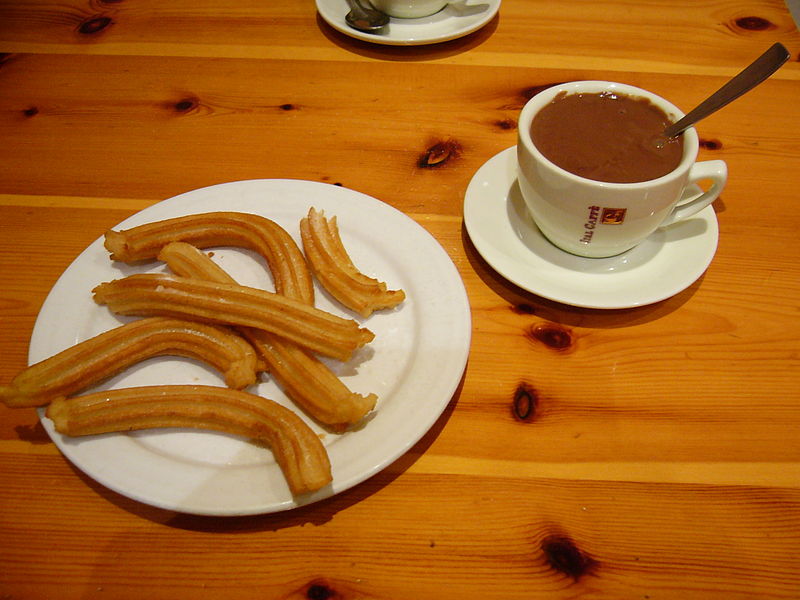
Completely unrelated to Japan is the super tasty Mexican dessert known as the churro. Thanks to a little wiki-chain (Mister Donuts -> Fast Food restaurants Japan -> FF Restaurants USA -> Taco John’s -> Churros) I now know that churros, despite us calling them Mexican desserts, actually comes from Spain (according to wiki anyways, but the articles cites no sources). Normally, without sources I would be in a considerable amount of doubt, but I would actually guess that they came over to Latin America and the “New World” with Spanish explorers. Supposedly, churros themselves came with Portuguese explorers from China originally, stemming from the Chinese donut (aka, youtiao). Because they did not know the proper technique for making the Chinese donut, they used their own, creating the five pointed star shaped churro we all know and love. According to someone on wiki, anyways.
Another website actually says that it was invented by shepherds as a food that could be easily cooked in a pan or even over a plain fire. From there it spread to Latin America. This website supports that idea as well, since they say that frying the bread was the only way to prepare their bread since “the microwave had not been invented yet.” Um, what happened to baking bread as a method of preparation?
Actually, this would be super interesting to figure out where it really came from, mostly because I love learning about where things originated (must be the Japanese side of me) and I love food.
Interesting food for thought though, even if it doesn’t actually cite any sources.
Oh, and through a google search, churro is also, apparently, a type of sheep. And supposedly the people who make the churro are called churreros.
They actually have churros here in Japan, though I haven’t been able to find a decent one like the ones back at home. The ones here… aren’t crunchy at all. They’re this kind of soft, donut like thing that, while tasty, doesn’t have the juxtaposition of crunchy on the outside, soft on the inside like churros do. And they had a glaze; no sprinklings of sugar waiting to drop nicely onto your pants. Those were just the churros at Mister Donuts though. I have the suspicion that if I go to Disneyland, I’ll be able to find a nice proper churro.
Subscribe to:
Posts (Atom)